
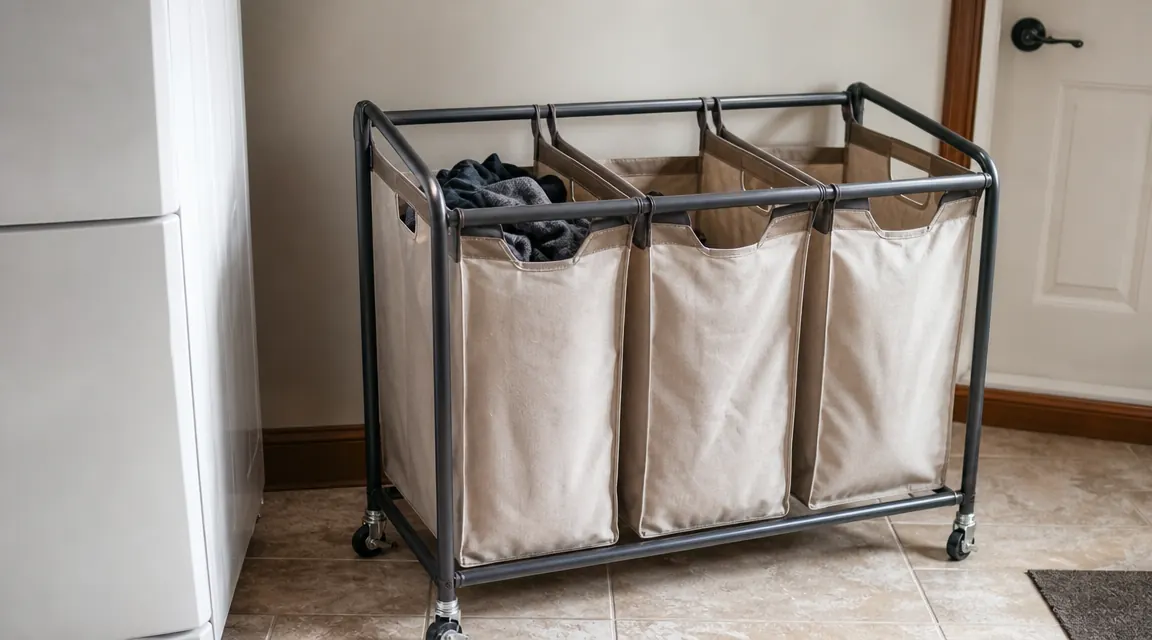
Somewhere in the middle of assembling the STORAGE MANIAC 3-section laundry sorter, I had a specific thought: whoever wrote the instruction sheet has never tried to hook a limp fabric bag onto a metal frame while the frame is tipping toward them. I got there eventually. Took twenty-six minutes, not the twelve that people cite in reviews. And the cart has been useful since. But the 22,000 Amazon ratings mostly describe the cart after a happy first week, and there are things that only show up after you have been living with it for a while, or after you have tried to use it in a space that is not a wide-open laundry room.
This is not the review where I tell you the cart changed my laundry routine. It did, mostly for the better. This is the review where I tell you about the bag sag on partial loads, the caster wobble that appears before everything is fully tightened during assembly, the tipping behavior when one section runs heavy, and the three kinds of buyers who order this cart, get it home, and quietly send it back. If you are on the fence, read this before you click Add to Cart.
The Quick Verdict
Solid cart if your laundry situation matches what it was designed for. Buy it wrong, meaning small apartment, narrow doorways, or heavy denim-only loads, and you will be annoyed within two weeks.
Amazon Check Today's Price →Still sorting from a single hamper every wash day? This cart does the sorting all week so you do not have to.
The STORAGE MANIAC 3-section rolling sorter carries a 4.6-star rating from over 22,000 buyers on Amazon. Before you decide, read the section below on who this does not work for. If your setup fits, it is genuinely one of the better options at this price point. Check today's price and stock below.
Amazon Check Today's Price on Amazon →How I Have Been Using It
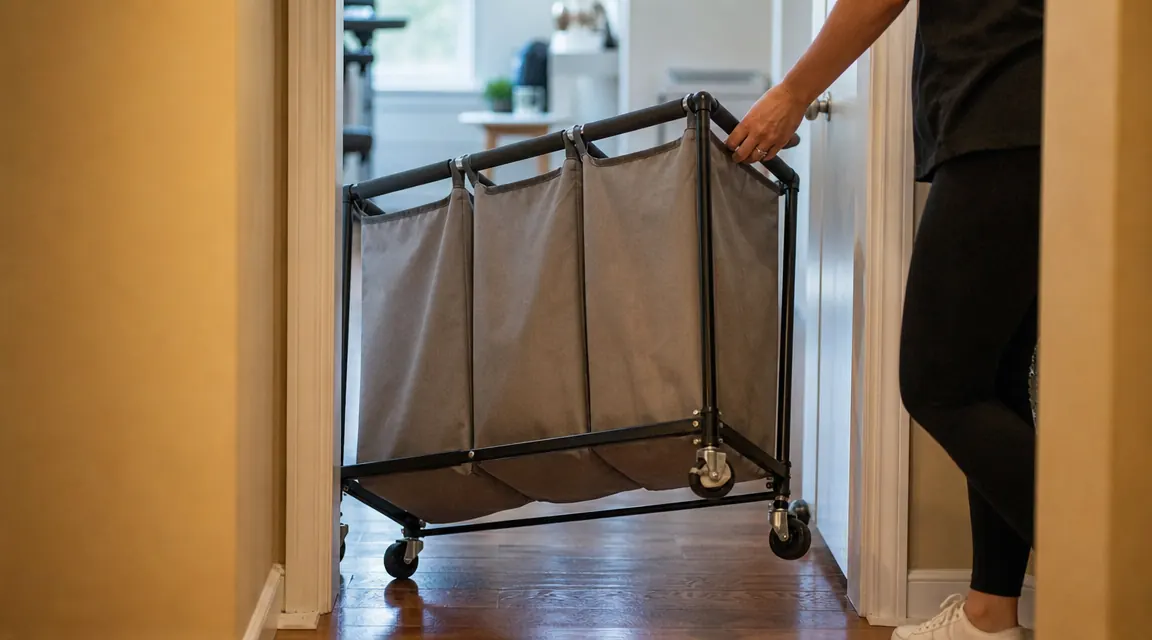
I set this cart up in a rental apartment with a stacked washer-dryer in a closet off the kitchen. The laundry closet door is 25 inches wide. The cart is 23.6 inches wide, which means it technically clears the opening, but rolling it through requires lining it up straight and pushing slowly. If I come in at any angle, the front caster catches the door trim. I have re-painted that door trim once already.
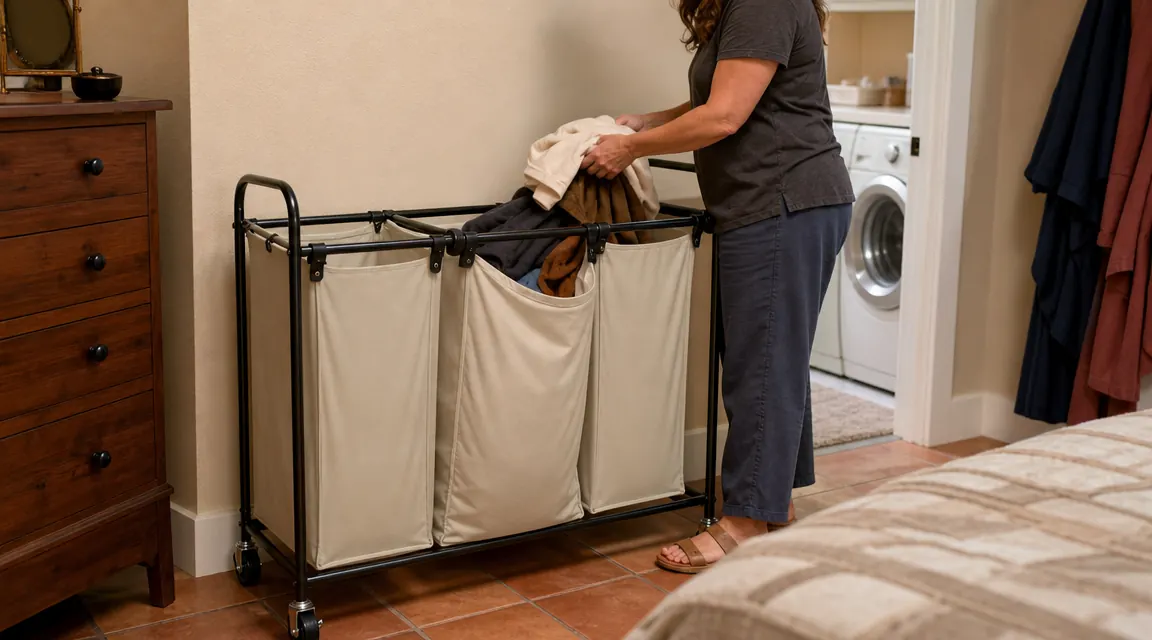
My household is two adults. I do laundry about twice a week, smaller loads rather than one massive Sunday haul. That use pattern exposes something that large-family reviewers do not notice: when you run smaller, more frequent loads, the bags are often only one-third to one-half full. And at partial fill, the fabric sags. The side bags lean outward. The center bag droops. The cart still works, but it looks like it is giving up. If visual tidiness in your space matters to you, partial loads do not look as organized as a fully loaded cart does.
I have been using this cart for about eight months. The frame is structurally fine. I am going to spend most of this review on the things that do not show up in first-week impressions, because that is what actually matters when you are deciding whether to spend the money.
The Assembly Experience Nobody Accurately Describes
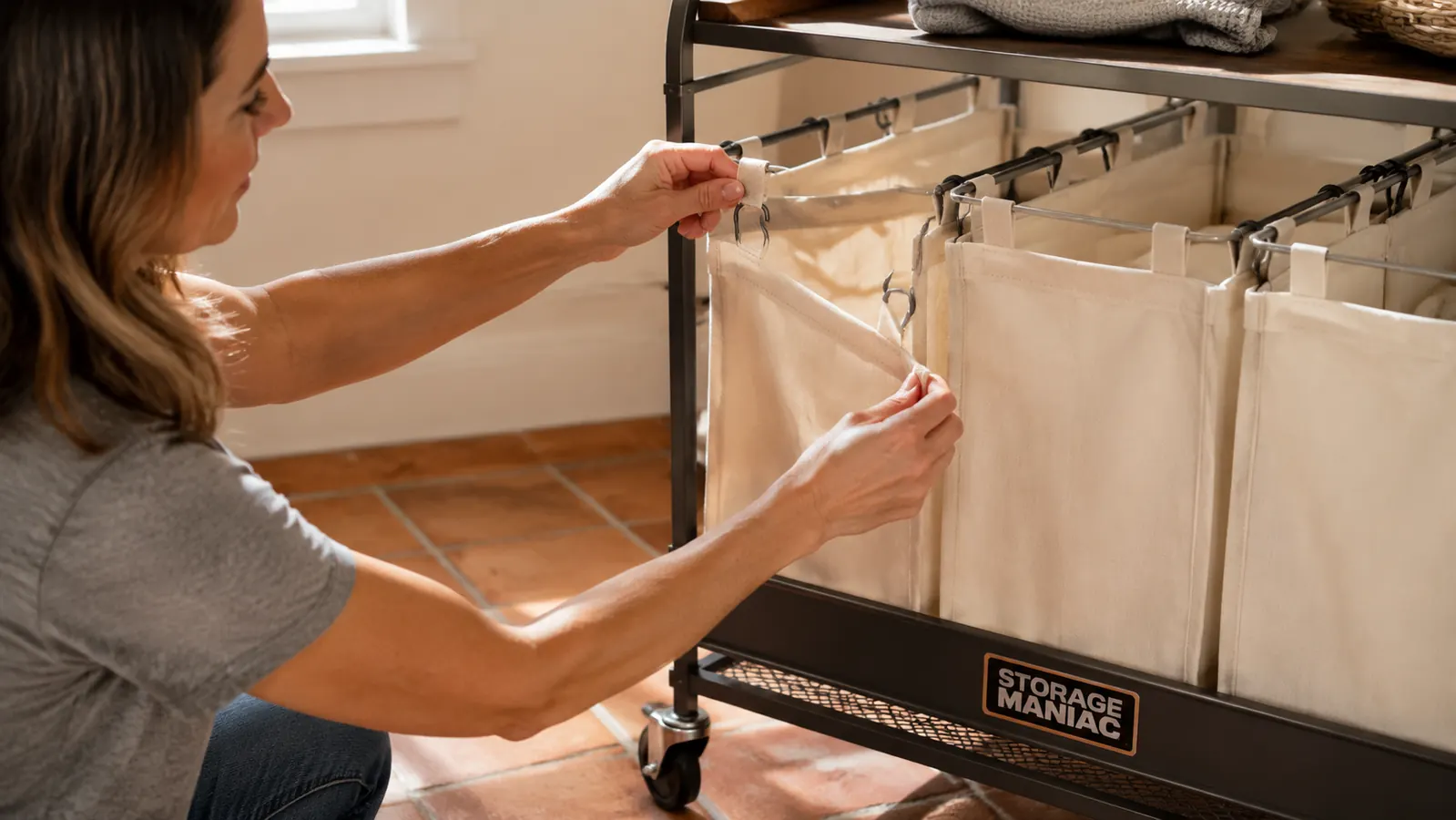
The box contains two vertical side poles, a horizontal top rail, a lower cross brace, four caster assemblies, mounting bolts, and three fabric bags with loop-and-hook attachment. The instruction sheet has four steps and is genuinely clear in the illustrations. The problem is not the instructions. The problem is that the frame is wobbly until you get the final bolts tight, and you are asked to hang the bags at step three, before the frame is fully secured at step four. Hanging a fabric bag on a frame that rocks back and forth when you lean over it is awkward. Two of my three bags went on crooked the first time and I had to re-do them after the frame was stable.
The casters screw onto threaded posts at the base of the side poles. You hand-tighten them, then snug them with a wrench. The critical thing nobody mentions: if you under-tighten even one caster, the cart will rock slightly when you pull a bag off. That rocking feels like structural looseness even though the frame joints are fine. I spent ten minutes convinced I had assembled something wrong before I realized one rear caster was a quarter-turn loose. Tighten all four casters firmly before you test the cart. They can vibrate slightly loose during the first week of use too, so check them again after a few days.
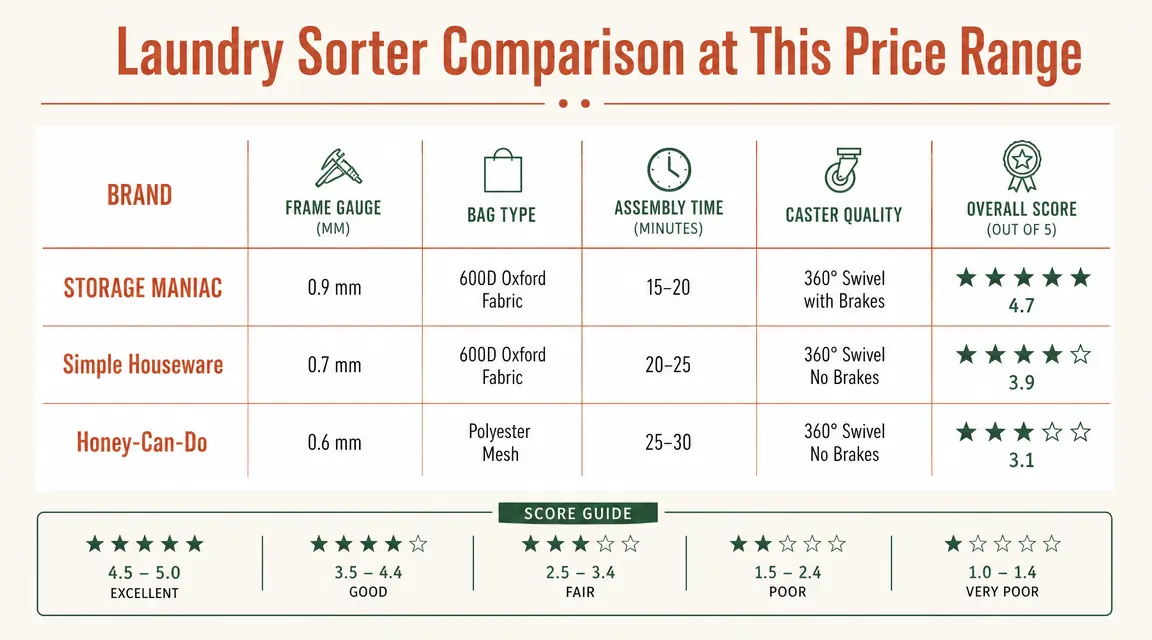
Assembly time depends on whether you have a helper. Solo, with a medium Phillips screwdriver and an adjustable wrench, I clocked twenty-six minutes. With two people it would probably be fifteen. The product listing says fifteen minutes. That number assumes two people and some prior experience with this kind of flat-pack steel assembly.
Bag Sag, Fabric Behavior, and What Nobody Posts a Photo Of
The three polyester-cotton bags each hold about 11.8 gallons at full capacity. The listings photos show them plump and upright, filled to the brim. Real life is more complicated. The bags have no internal structure, no stiffener panels, no wire rim. They are fabric loops hanging from four metal hooks per bag. When full, the hooks pull the bag open and the weight keeps it taut. When half full, the bag collapses inward at the top and the sides droop outward. The hooks stay engaged but the bag looks deflated.
After eight months, the fabric on the outer bags has some visible stretch marks at the corners where the loops attach to the hooks. No tearing, but the fabric has memory now and holds a slightly wider shape even when empty. The center bag, which carries my lights and sees the most varied fabric types, has softened the most. It sags lower off the hooks than it did new. Again, structural fine. Visually not what the product photos suggest.
If you are someone who cares about how a utility piece looks in your space, this is an important honest note. The cart looks neat and purposeful when fully loaded. It looks a little forlorn when the bags are partially filled with a few days worth of clothes. That is not a design flaw. It is just the physics of unsupported fabric. But reviewers who shoot their hero photo on day two, with perfectly filled bags, are not showing you Tuesday afternoon when you have thrown in three shirts and nothing else.
The ratings are earned on wash day. What they do not capture is the Tuesday afternoon version: partially filled bags, a slightly saggy frame, and the moment you realize the cart is wider than your laundry closet door frame wanted to cooperate with.
Tipping and Weight Distribution
The cart is 13.4 inches deep, which is fairly shallow relative to its 23.6-inch width. That geometry matters when one section is loaded significantly heavier than the others. A load of wet towels or heavy denim in one side bag shifts the center of gravity toward that side. The casters are large enough that the cart will not tip under normal loads, but on smooth floors, a heavily loaded single bag will cause the cart to drift toward the loaded side when you push it. It is subtle but noticeable if you are rolling it a distance.
Where tipping becomes a real concern is when you pull one bag off to carry to the machine. If the other two bags are both full at the time, removing one load shifts the weight suddenly. On hardwood without the caster locks engaged, the cart has rolled away from me twice during bag removal. Both times it stopped before hitting anything, but it is the kind of moment that makes you check the floor and re-engage the locks. Habit fixed it. But it is a gotcha the reviews skip.
The two front casters have a lock tab. The two rear casters do not. When I park the cart for a week of loading, I lock the front two and the cart stays put. When I pull a bag on hardwood without the locks on, it moves. That is user error on my part, but it is also worth knowing before you park this on a sloped laundry room floor or a polished concrete basement.
The Three Situations Where People Regret Buying This
After reading through several pages of the lower-rated Amazon reviews, the regret patterns are consistent. The first is apartment laundry closets. Standard apartment laundry closet doors are 24 inches wide. This cart is 23.6 inches wide. Those four-tenths of an inch are the theoretical clearance. In practice, the door frame is never perfectly parallel, the casters have some play, and rolling a loaded cart through that opening requires patience every single wash day. People who have to do this several times a week find it stops being worth the effort.
The second situation is heavy fabric households. If your household generates a lot of heavy denim, canvas workwear, or thick hoodies, the bags fill faster by weight than by volume. A bag that is half-full by visual volume can be loaded enough to make removal awkward, and the hooks take more strain than they do with lighter cotton loads. The bags hold up, but the experience of lifting a heavy partial bag off a hook, with the frame wobbling slightly, is less clean than the product suggests.
The third situation is solo households with tight floor space. The cart's footprint is 23.6 by 13.4 inches. That is meaningful floor space in a small apartment bedroom or bathroom. A single person does not need 35.6 gallons of sorting capacity, and a single well-made hamper with removable bags will serve the space better with a fraction of the footprint. Buying this cart for a one-person household is overkill in both capacity and physical size.
What I Liked
- Steel frame assembly is straightforward once all four casters are fully tightened
- Hook-and-loop bag system makes bag removal and carrying genuinely easy when loads are full
- Total 35.6-gallon capacity handles a three-to-four person household without overfilling
- Quiet rolling on carpet and tile once casters are properly seated
- Bags are sold separately as replacements, so bag wear does not require replacing the frame
- Front caster locks keep the cart stationary during loading on smooth floors
Where It Falls Short
- Bag sag is visible on partial loads, the bags have no structure to hold shape when not full
- Assembly wobble during step three confuses people into thinking the frame is defective
- 23.6-inch width leaves essentially no margin in a standard 24-inch apartment closet doorway
- One-sided heavy loads cause cart drift on smooth floors if locks are not engaged
- Rear casters have no locks, so only front two can be locked against rolling
- Frame rocking during bag removal if any caster is under-tightened
Who This Is For
This cart makes clear sense for households running laundry for three or more people in a space where the cart can live permanently without having to roll through a tight doorway every use. A dedicated laundry room with a standard 28-inch or wider door, a hallway where the cart parks between rooms, or a basement utility area where it never needs to navigate a door frame, these are the situations where the cart just works and keeps working. If your kids or partner will actually use separate bins, the pre-sorting payoff is real. If your doorways are wide and your wash days are currently built around sorting a pile on the floor, this cart solves an actual problem.
Who Should Skip It
Skip this cart if your laundry access is through a 24-inch door and you have to move the cart through that door every wash day. The clearance is too tight to be pleasant over hundreds of wash cycles. Skip it if you live alone or do laundry for two people on a frequent schedule. The capacity is more than you need and the footprint is hard to justify in a small space. Skip it if you want a laundry piece that looks tidy at all times regardless of fill level. Partially loaded bags sag and the cart looks utilitarian, not decorative. And skip it if your floor has any real slope in the laundry area and you do not want to think about locking casters every time you load a bag. For a full side-by-side comparison against a single hamper setup, the laundry sorter cart vs single hamper breakdown covers the time-cost math in detail. If you have already decided a three-section sorter is the right move and just want to know whether this specific model earns the purchase, the long-term use review covers the twelve-month picture.
Know the gotchas going in and this cart delivers. Tight doorways, partial loads, heavy denim households, those are the exceptions. Everyone else benefits.
The STORAGE MANIAC 3-section rolling laundry sorter has earned its 4.6-star average from 22,000-plus buyers on Amazon. Check today's price and confirm your doorway width before ordering. The four-tenths of an inch matters.
Amazon Check Today's Price on Amazon →